Lore · Continents & Moons
Antonica
Antonica was not always called Antonica, and its history reaches well beyond the road between Qeynos and Freeport. SOE’s 2002 atlas, *The Maps of Myrist*, gathers that history from scattered places: a vanished elven forest, an ogre dominion, human wanderers, departing giants and arriving gnolls. The continent holds the remnants of peoples who left as well as the cities of those who stayed. Its older name, Tunaria, joins those separate histories on the same land.
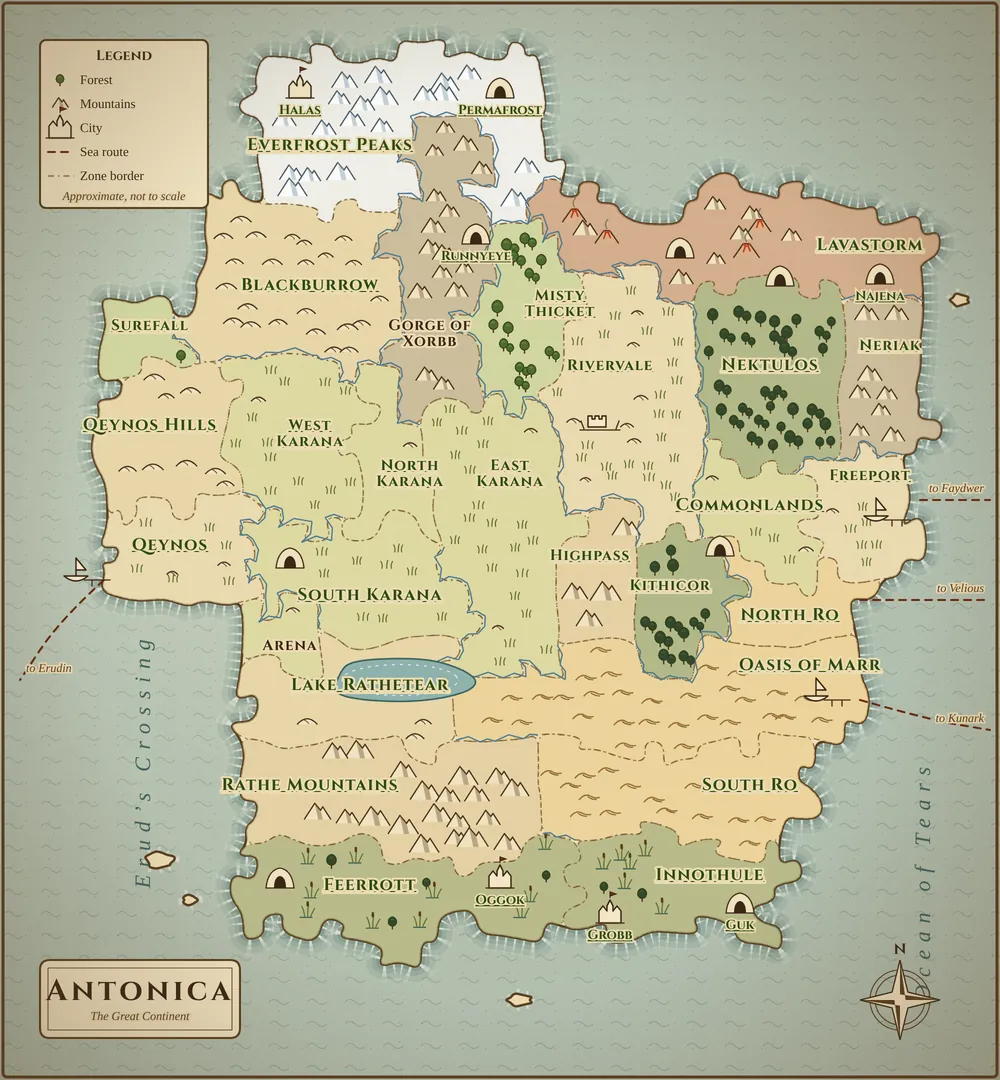
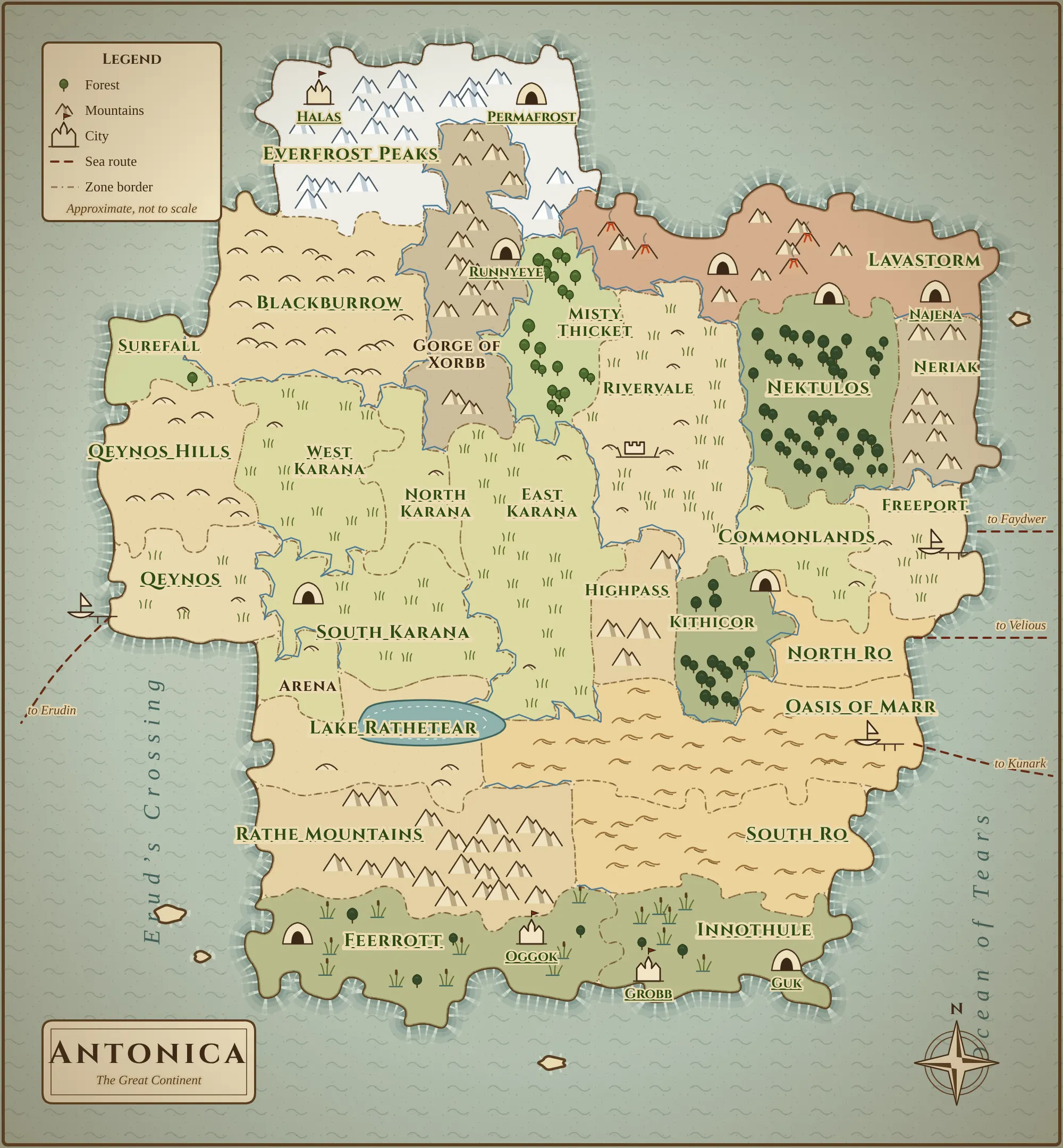
Show 56 zone connections
- Butcherblock Mountains ↔ Ocean of Tears (ship route)
- Freeport ↔ Ocean of Tears (ship route)
- Oasis of Marr ↔ Timorous Deep (ship route)
- Qeynos ↔ Qeynos Hills (zone line)
- Erud’s Crossing ↔ Qeynos (ship route)
- Qeynos ↔ Qeynos Aqueducts (zone line)
- Qeynos Hills ↔ Surefall Glade (zone line)
- Blackburrow ↔ Qeynos Hills (zone line)
- Qeynos Hills ↔ West Karana (zone line)
- Jaggedpine Forest ↔ Surefall Glade (zone line)
- Blackburrow ↔ Jaggedpine Forest (zone line)
- Blackburrow ↔ Everfrost Peaks (zone line)
- Everfrost Peaks ↔ Halas (zone line)
- Everfrost Peaks ↔ Permafrost Keep (zone line)
- North Karana ↔ West Karana (zone line)
- North Karana ↔ South Karana (zone line)
- East Karana ↔ North Karana (zone line)
- Lake Rathetear ↔ South Karana (zone line)
- South Karana ↔ Lair of the Splitpaw (zone line)
- East Karana ↔ Highpass Hold (zone line)
- East Karana ↔ Gorge of King Xorbb (zone line)
- Highpass Hold ↔ Kithicor Forest (zone line)
- High Keep ↔ Highpass Hold (zone line)
- Kithicor Forest ↔ Rivervale (zone line)
- The Commonlands ↔ Kithicor Forest (zone line)
- Misty Thicket ↔ Rivervale (zone line)
- Misty Thicket ↔ Clan Runnyeye (zone line)
- Gorge of King Xorbb ↔ Clan Runnyeye (zone line)
- Befallen ↔ The Commonlands (zone line)
- The Commonlands ↔ Freeport (zone line)
- The Commonlands ↔ Nektulos Forest (zone line)
- The Commonlands ↔ North Ro (zone line)
- Freeport ↔ North Ro (zone line)
- Iceclad Ocean ↔ North Ro (ship route)
- North Ro ↔ Oasis of Marr (zone line)
- Oasis of Marr ↔ South Ro (zone line)
- Innothule Swamp ↔ South Ro (zone line)
- Nektulos Forest ↔ Neriak (zone line)
- Lavastorm Mountains ↔ Nektulos Forest (zone line)
- Lavastorm Mountains ↔ Najena (zone line)
- Lavastorm Mountains ↔ Solusek’s Eye (zone line)
- Lavastorm Mountains ↔ Nagafen’s Lair (zone line)
- Lavastorm Mountains ↔ Temple of Solusek Ro (zone line)
- Nagafen’s Lair ↔ Solusek’s Eye (zone line)
- Lake Rathetear ↔ The Rathe Mountains (zone line)
- Lake Rathetear ↔ The Arena (zone line)
- The Feerrott ↔ The Rathe Mountains (zone line)
- The Feerrott ↔ Innothule Swamp (zone line)
- The Feerrott ↔ Oggok (zone line)
- The Feerrott ↔ Lost Temple of Cazic-Thule (zone line)
- The Feerrott ↔ Plane of Fear (zone line)
- Grobb ↔ Innothule Swamp (zone line)
- Guk ↔ Innothule Swamp (zone line)
- Temple of Solusek Ro ↔ Solusek Ro’s Tower (planar portal)
- Plane of Fear ↔ The Plane of Tranquility (planar portal)
- Plane of Hate ↔ The Plane of Tranquility (planar portal)
The name beneath the name
The atlas’s Qeynos entry credits the second Antonius Bayle, crowned in 5191, with leading the movement to have “the continent of Tunaria renamed Antonica, ostensibly in honor of his father”. It adds the sages’ wry observation that the king shared his father’s name. The dynasty itself has its own Qeynos history; these older continental stories happened on a land then called Tunaria. Source [1]
The atlas’s northern Ro entry places the ancient Elddar forest across the later deserts of Ro and the Oasis of Marr. Its legends describe “the former home of the elves who had once resided upon Antonica, then called Tunaria”. The Elddar and Takish-Hiz connect that older woodland to the desert, while Faydwer carries the story onward across the sea. Source [2]
Dominion before the human cities
The atlas’s entry on the war god states that “The ogres once held dominion over much of Tunaria”. Their assault on the Plane of Earth and the curse that followed belong to Rallos Zek and the ogres’ own history. Across Antonica, their descendants and ruins are reminders of a dominion older than the present human cities. Source [3]
Humans arrived as wanderers rather than founders of those cities. Describing Jaggedpine, the atlas recalls a time “when humans were still but nomadic tribes recently split from their barbarian foundations”. The Northmen of Halas and the humans of the plains thus share a history before their division into different peoples and different homes. Source [4]
Peoples leaving and arriving
The atlas’s Permafrost entry notes that most of the Ice Giants who raised the castle “have long since departed Antonica for the icy shores of Velious”. Their northern stronghold remained with arctic creatures and the dragon’s servants. The continent’s frozen edge preserves a trace of that departing giant presence; Nagafen and Vox connect the northern keep with another lair beneath the continent’s volcanic country. Source [5]
Movement also ran toward Antonica. The atlas describes the Ishva Mal as “instrumental in guiding his people to Antonica and overtaking the Splitpaw”. The gnolls of the southern plain were newcomers who took an existing lair by force, not the northern clan whose history belongs to Blackburrow and the Sabertooths. Source [6]
Above the grass and below the mountain
The southern Karana entry names “The aviaks of Antonica, a primitive race of birdmen”, living on platforms above the grass and naturally hostile to ogres. Centaurs occupied a village farther north. The atlas describes the plain’s dull-feathered aviaks as cousins of the brighter birds of the Ocean of Tears islands, joining the inland grasslands to life beyond the coast. Source [7] Source [8]
The atlas calls Nagafen’s home beneath Lavastorm the lair under “the most active volcanic crevasse in all of Antonica”. Goblins dug it and giants finished it. Fire beneath the mountain belongs beside the grasslands and frozen north in the continent’s portrait, without turning the dragon’s separate history into a second account here. Source [9]
Between the coasts
The eastern Karana entry describes the Serpent River as “a wide waterway that cuts through the whole of Antonica from north to south”. Legend credits giants with its bridge. The atlas calls Highpass Hold “the only "safe" point of travel between the two human cities of Antonica”. Source [10] Source [11]
Three seas beyond the shore
Erud’s Crossing lies “between Antonica and Odus”, the route of Erud’s emigrants and the trade lane linking Qeynos with Erudin. The Ocean of Tears separates Antonica from Faydwer, while the Timorous Deep separates both from Kunark. The atlas’s sea entries therefore place Antonica in a wider world of migration and trade, rather than treating either human port as the edge of its history. Source [12] Source [8] Source [13]
The original lands and the later game
SOE’s 2006 announcement said the first progression servers, The Combine and The Sleeper, would open June 28 with “the original EverQuest zones in Antonica, Faydwer and Odus that were available at launch back in 1999”. Player progress would unlock later expansions. Source [14]
Daybreak’s progression FAQ distinguishes that model from a true “Classic” server using “only assets and content that was available in March of 1999”; progression retains later maps and interface improvements. This is a history of the continent, not a promise of a frozen ruleset. The Antonica geography companion supplies the regional map, level ranges and zone list alongside this account of the peoples who crossed and changed the land. Source [15]
Sources
[1] *EverQuest Atlas: The Maps of Myrist* (Sony Online Entertainment, 2002), "Qeynos, Northern", Notable NPCs, pp. 366–367. — https://archive.org/details/ever-uest-atlas-the-maps-of-myrist · [2] *EverQuest Atlas: The Maps of Myrist* (Sony Online Entertainment, 2002), "Desert of Ro, Northern", Background, pp. 86–87. — https://archive.org/details/ever-uest-atlas-the-maps-of-myrist · [3] *EverQuest Atlas: The Maps of Myrist* (Sony Online Entertainment, 2002), "Rallos Zek", pp. 524–525. — https://archive.org/details/ever-uest-atlas-the-maps-of-myrist · [4] *EverQuest Atlas: The Maps of Myrist* (Sony Online Entertainment, 2002), "Jaggedpine Forest", Background, pp. 222–223. — https://archive.org/details/ever-uest-atlas-the-maps-of-myrist · [5] *EverQuest Atlas: The Maps of Myrist* (Sony Online Entertainment, 2002), "Permafrost Caverns", Background, pp. 338–339. — https://archive.org/details/ever-uest-atlas-the-maps-of-myrist · [6] *EverQuest Atlas: The Maps of Myrist* (Sony Online Entertainment, 2002), "Splitpaw Lair", Notable NPCs, pp. 426–427. — https://archive.org/details/ever-uest-atlas-the-maps-of-myrist · [7] *EverQuest Atlas: The Maps of Myrist* (Sony Online Entertainment, 2002), "Karana, Southern", Background, pp. 244–245. — https://archive.org/details/ever-uest-atlas-the-maps-of-myrist · [8] *EverQuest Atlas: The Maps of Myrist* (Sony Online Entertainment, 2002), "Ocean of Tears", Background, pp. 322–323. — https://archive.org/details/ever-uest-atlas-the-maps-of-myrist · [9] *EverQuest Atlas: The Maps of Myrist* (Sony Online Entertainment, 2002), "Nagafen’s Lair", Dangers, pp. 292–293. — https://archive.org/details/ever-uest-atlas-the-maps-of-myrist · [10] *EverQuest Atlas: The Maps of Myrist* (Sony Online Entertainment, 2002), "Karana, Eastern", Background, pp. 238–239. — https://archive.org/details/ever-uest-atlas-the-maps-of-myrist · [11] *EverQuest Atlas: The Maps of Myrist* (Sony Online Entertainment, 2002), "Highpass Hold", Benefits, pp. 202–203. — https://archive.org/details/ever-uest-atlas-the-maps-of-myrist · [12] *EverQuest Atlas: The Maps of Myrist* (Sony Online Entertainment, 2002), "Erud’s Crossing", Background, pp. 114–115. — https://archive.org/details/ever-uest-atlas-the-maps-of-myrist · [13] *EverQuest Atlas: The Maps of Myrist* (Sony Online Entertainment, 2002), "Timorous Deep", Background, pp. 470–471. — https://archive.org/details/ever-uest-atlas-the-maps-of-myrist · [14] SOE, "Progression Server Timeline Sample", Jun 27, 2006 — https://www.everquest.com/news/imported-eq-enus-50178 · [15] Daybreak, "EverQuest Progression Servers" — https://www.everquest.com/news/eq-what-is-a-progression-server
Retold in our own words from the sources listed on this page; short quotes are marked and sourced.