Lore · Lands & Places
Droga and Nurga, the Mountain Death Mines
The atlas dates the goblins’ arrival to the empire’s collapse: "The goblin tribes invaded Kunark when they heard of the fall of the Iksarian Empire." Landing in the north, they pushed into "the forests, hills, and every crack of the Frontier Mountains." Source [1]
Three tribes, two cities
They set up "two city-mines, Nurga and Droga, and numerous outposts" and split into "three warring tribes, which occasionally unite – Bloody Guts, Mountain Death, and Cleaving Tooth." The atlas calls them "resourceful" and quick to multiply, "giving them some advantage over the Sarnak and the Giants." Source [1]
The Game Master’s Guide says the same: "Two city-mines, Nurga and Droga, are the largest population centers of the Mountain Death tribe of goblins." It adds that the giants hold the surface, while the goblins have dug "mines and twisting passageways that run beneath large stretches of the mountains." Source [5]
The Bloody Guts live elsewhere, holding the goblin city of Twark in Warslik’s Woods, "the largest single population center of goblins on Kunark." Source [6]
The Temple of Droga
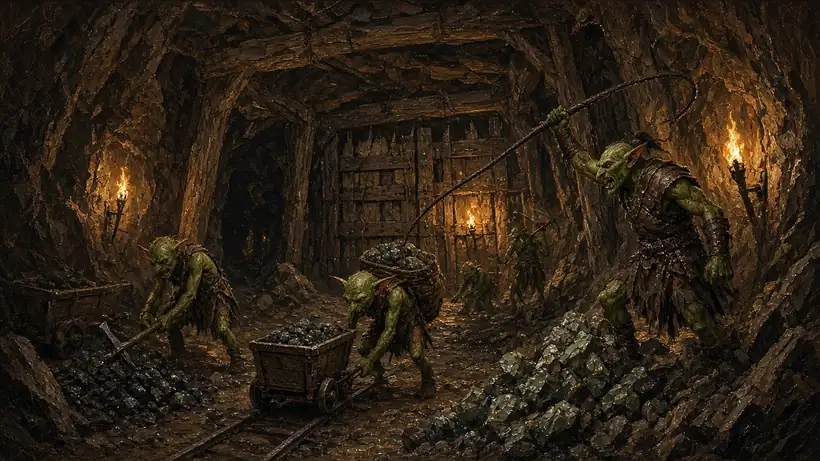
Droga is the larger mine, "used much more than the neighboring Nurga." Its entrance is "carved in the side of a solid rock mountain in the northeastern corner of the Frontier Mountains." A long tunnel called the Main Hall, "fortified with rock and wooden gates", runs to Outpost Droga, "the hub of Droga’s mining activity." Source [1]
Deep inside lies Death Hollow, "the lair of the Mountain Death Goblins and their chief, Rokgus." Droga and Death Hollow are built mostly of rock and stone brick, while the few buildings of Outpost Nurga are "made of old, rotting wood." Source [1]
Goblin slaves "toil endlessly in the mines", kept in line by goblin Whip-Crackers. The tunnels are roughly carved and held up in places by "Old, rotting support beams", though the busier ones have stone block walls. Source [2]
A one-way trap
The temple is "a one-way, linear progression". The atlas tells groups to bring "a druid or wizard that may open a portal in the event of emergency – for once inside the mines, the Temple of Droga offers no escape." The goblins "attack in coordinated efforts, and are rarely caught alone", and they are its only listed monsters, at levels 15-40. Source [1]
Chief Rokgus
Rokgus is driven by "a personal hatred and thirst for vengeance", and sends "armies" of goblins ("soldiers, miners, and civilians alike") against the sarnak outposts of the range. "Almost every goblin fears Rokgus’ words, for none know when next he shall call for such an assembly." Source [2]
When he was young he "witnessed the brutal slaughter of nearly a hundred members of his tribe" by "a small band of Sarnak soldiers", who caught them resting after "a fortnight’s mining venture." Since that night he "has vowed to destroy all Sarnaks at all costs." Source [2]
His rule brought "relative prosperity", and sarnak raids on the mines became "all but impossible." His order "sealed all second entrances to the temples of both Droga and Nurga, making the mines a linear trap for any army." Source [2]
War on the sarnak
The Game Master’s Guide calls him "The goblin king Rokgus", who "rules his tribe from Droga and sends his people to war against the sarnak, who are expanding their empire from Chardok into the Frontier Mountains." Source [5]
The Mines of Nurga
Nurga is "the lower mining system", joined to Droga by "long, narrow tunnels". Each has its own exit to the surface, but "one can enter Nurga’s lower passages only through the upper levels of Droga." Its goblins, hardened by "years of hard, intensive labor", are "exceptionally strong and resilient"; the atlas rates the mines at levels 25-45. Source [3]
Its outpost is "not much more than a small, rotting wooden watchtower and fort", and the Nurga Mining Camp is "a couple of decrepit wooden buildings, surrounded by dirty hide tents." A wooden gate across the main tunnel to the surface "was erected during Rokgus’ campaign". Source [3]
"Many goblins in the lower levels feel themselves to be quasi-independent from the rest of the Mountain Death Clan, and do not uphold the ritualistic ceremonies and fealty to the clan chief that the goblins of Droga strive to maintain." Source [4]
Trunt, Nuggleruk and a golden earring
"A strange Ogre Monk by the name of Trunt has journeyed to the Mines of Nurga for an unknown purpose." The goblins "do not seem to mind", and many monks come "to seek the wisdom of Trunt or to challenge this mysterious ogre in battle." Source [4]
The Game Master’s Guide names Nuggleruk, "an undead goblin king formerly of the Mountain Death tribe", as leader of Venril Sathir’s outpost of Varis, which spies on and raids Firiona Vie. Its Earring of Essence, which looks like "simple earrings of pure gold" and is favored by soothsayers, "first came to be known among the goblins of Droga." Source [6] Source [7]
Droga returns
In 2016, Daybreak’s September producer’s letter listed "Droga" among the new zones of Empires of Kunark. Source [8]
Sources
[1] Sony Online Entertainment, EverQuest Atlas: The Maps of Myrist (print, 2002), “Temple of Droga”, p. 101 · [2] Sony Online Entertainment, EverQuest Atlas: The Maps of Myrist (print, 2002), “Temple of Droga”, “Notable NPCs: Chief Rokgus”, p. 102 · [3] Sony Online Entertainment, EverQuest Atlas: The Maps of Myrist (print, 2002), “Mines of Nurga”, p. 315 · [4] Sony Online Entertainment, EverQuest Atlas: The Maps of Myrist (print, 2002), “Mines of Nurga”, “Notable NPCs: Trunt”, p. 316 · [5] White Wolf, EverQuest Role-Playing Game: Game Master’s Guide (print, 2002), “Frontier Mountains”, p. 24 · [6] White Wolf, EverQuest Role-Playing Game: Game Master’s Guide (print, 2002), “Varis” and “Warslik’s Woods”, p. 25 · [7] White Wolf, EverQuest Role-Playing Game: Game Master’s Guide (print, 2002), “Earring of Essence”, p. 129 · [8] EverQuest.com, Holly “Windstalker” Longdale, “September 2016 EQ Producer’s Letter: Let’s Talk Expansion” (Sep 1, 2016)
Retold in our own words from the sources listed on this page; short quotes are marked and sourced.