Luclin · The Shadows of Luclin
Ssraeshza Temple
Ssraeshza Temple is the blue-black metal pyramid hidden inside airless The Grey, where the surviving Shissar still rule their Iksar slaves beneath Emperor Ssraeshza.
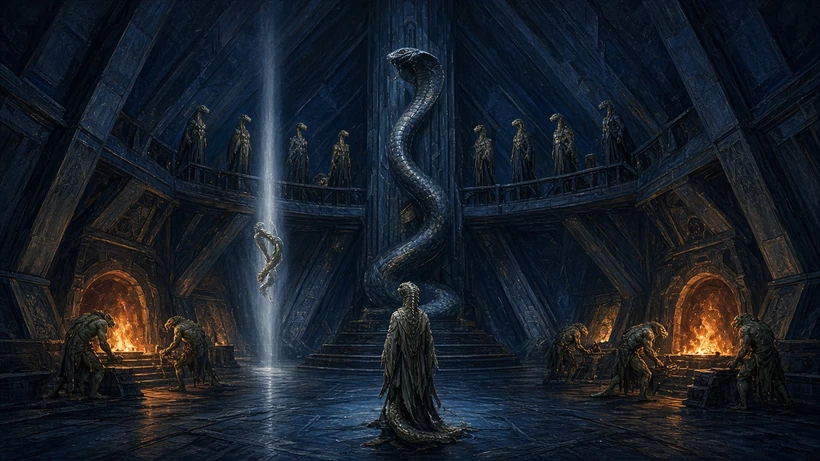
A blue-black pyramid in the void
The EverQuest Atlas: The Maps of Myrist indexes “Ssraeshza Temple” at page 428 and maps it across multiple tiers. Its level 1 key lists “A. To The Grey,” “B. Ssraeshza Temple Basement,” “C. To Ssraeshzha Temple L1B,” “D. To the Throne Room” and “E. To Ssraeshza Temple L2,” while the basement key marks “A. To Ssraeshza Temple L1” and “B. Mines.” Source [1]
The structure defines the skyline of The Grey: “The temple of Ssraeshza is an enormous pyramid, built by the Shissar to conduct rituals of the black arts undisturbed. Found in The Grey of Luclin, the temple exists both below and above ground and its pyramid is constructed from a blue-black metallic substance.” Overhead, “The sky above the pyramid is perpetually black and stormy, occasionally lit up by a streak of lightning,” while “All around the tower, huge slabs of the blue-black metallic ore used in its construction can be seen moving in different patterns.” Source [1]
Just reaching the doorway demands preparation: “It is also necessary to bear an enchantment that enables one to survive in an airless environment, as traveling parties must trek through The Grey to reach the temple area.” A hidden passage from The Deep also reaches its lower reaches. Source [1] Source [7]
Floors, vacuum columns and Iksar slaves
Entry begins midway up the pyramid: “The entrance to the pyramid is hidden on the shadowed side and opens up to the middle floor. Travel between floors is done via cylindrical vacuum columns that allow the inhabitants to move up or down. The temple’s underlying structure is geometric and symmetrical in nature, reflecting the Shissar’s core architectural values.” Source [1]
Each tier serves a caste. “The mid-section, entry level of the pyramid features the highest concentration of temple guards, the guard barracks, and many traps. The upper floors of the temple are where the arcane masters reside and perform their rituals. At the very top of the pyramid is a large room, with many summoning circles ornately inlaid with magical runes.” Source [1]
Beneath them, “The bottom of the temple houses slave workers, merchants, commoners, families of the guards, and the general populace.” At its center stands “a one hundred and fifty foot tall statue of a snake, made of the same blue-black substance that makes up the pyramid,” ringed by “Huge furnaces” in all four corners where “A contingent of Iksar slaves are forced to run the smelting furnaces, clean the temple, and do basically all manual labor needed.” Once a day those slaves “gather in the chapel to hear the high priest of the arcane, who stands in the center and gives a sermon designed to instill propaganda and fear.” Source [1]
Emperor Ssraeshza and the Kunark treasures
The atlas bestiary rates monsters at levels 50–65, naming “Shissar Lich,” “Shissar Revenant,” “Temple Guards,” “Iksar Slaves,” “Flesh Golems” and “Thought Leeches.” It cautions that “Extremely xenophobic, the Shissar and their minions have no tolerance for any creature that dares to penetrate the temple walls,” and because they “attack in coordinated units,” it urges “the companionship of many powerful comrades.” Source [1]
At the top sits the notable NPC: “Emperor Ssraeshza serves as both military and spiritual leader for the Shissar Empire, and demands both respect and fear from his subjects.” Combining “his mastery over the arts of necromancy, evocation, and the mind,” the atlas warns that “Few, if any, could stand against him in combat.” What draws raiders inside is older still: “The Temple of Ssraeshza is rumored to hold treasures of a dreadful era long since past in Kunark’s history,” whose enchantments have grown stronger over time. SOE’s 2018 progression primer calls it “one of the most threatening places on all of Luclin,” adding: “Many fail to make it back.” Source [1] Source [7]
Patch notes and the February 2002 tale
SOE adjusted the raid zone across its first year after The Shadows of Luclin opened on December 4, 2001. On December 12, 2001 it “Improved pathing in The Temple of Ssraeshza,” on January 8, 2002 it “Fixed a problem that was still allowing people to Cast Eye of Zomm in Ssra Temple,” and on May 8, 2002 it “Modified several NPCs in the temple of Ssraeshza to address the disparity between melee and caster effectiveness in the zone.” Later, on March 13, 2003, it noted: “The Taskmaster's pouch should be dropping normally again in Ssraeshza.” Source [2] Source [3] Source [5] Source [6] Source [7]
On February 13, 2002, SOE’s patch message also carried an in-world tale set in Cabilis. Beside the black waters of the aqueducts, Grand Master Glox is handed “a glistening serpentine scale” and the symbol of the Soriz, “the ancient Iksar tribe that had been the slaves of the Shissar empire,” by a dying pupil who points up at the moon and whispers: “"sSs... Ssraeshza... has... returned..."” Source [4]
Lore tied to this zone
Sources
[1] Sony Online Entertainment, EverQuest Atlas: The Maps of Myrist, “Ssraeshza Temple,” pp. 428–434 (print). [2] Official EverQuest patch message, December 12, 2001, https://www.eqarchives.com/patch/view/2001-12-12-1 [3] Official EverQuest patch message, January 8, 2002, https://www.eqarchives.com/patch/view/2002-01-08-1 [4] Official EverQuest patch message, February 13, 2002, https://www.eqarchives.com/patch/view/2002-02-13-1 [5] Official EverQuest patch message, May 8, 2002, https://www.eqarchives.com/patch/view/2002-05-08-1 [6] Official EverQuest patch message, March 13, 2003, https://www.eqarchives.com/patch/view/2003-03-13-1 [7] Sony Online Entertainment press release, December 3, 2001; official patch message, December 4, 2001; and “Progression Primer: The Shadows of Luclin,” everquest.com, November 20, 2018, https://www.everquest.com/news/eq-shadows-of-luclin-progression-primer